

Construction Site Tools – On the Go With the Poolar.Project App
Connecting the office and the building site: With the construction site tools, project members can access up-to-date plans, documents and contact details whilst on site, record defects directly on site and document project progress in the site diary. All information remains linked to the central project workspace.
Poolar.Project
Project Data Where It’s Needed.
Digital Construction Site Tools for Desktop and Mobile Devices
The construction site tools support site management, planning and construction project management in making structured use of information from the construction phase, documenting it accurately and sharing it collaboratively within the project context.

Defect Management and Task Tracking
Record defects on your mobile exactly where they are located and track them reliably. On site and in the office.
Photos & Map Locations
Offline Mode in the App
Deadlines
Responsibilities
“We used to have Excel spreadsheets that required a great deal of effort to maintain. With the defect management system, we now have a proper workflow and can directly involve the relevant parties via email and by granting them access.”
Jens Esslinger, Project Manager at EEW Energy from Waste GmbH

Site Diary
Document daily activities, progress and specific details in a structured manner within the project. Recorded chronologically, transparently and in a way that is easy to follow.
Day/Week/Month
Automatic Weather Data
Mobile App
PDF Generation
“For us, the electronic site diary has replaced the long-outdated, inefficient and error-prone system of paper-based record-keeping. […] Many contractors were happy to keep the site diary and quickly recognised the significant added value it offered them.”
Jens Esslinger, Project Manager at EEW Energy from Waste GmbH
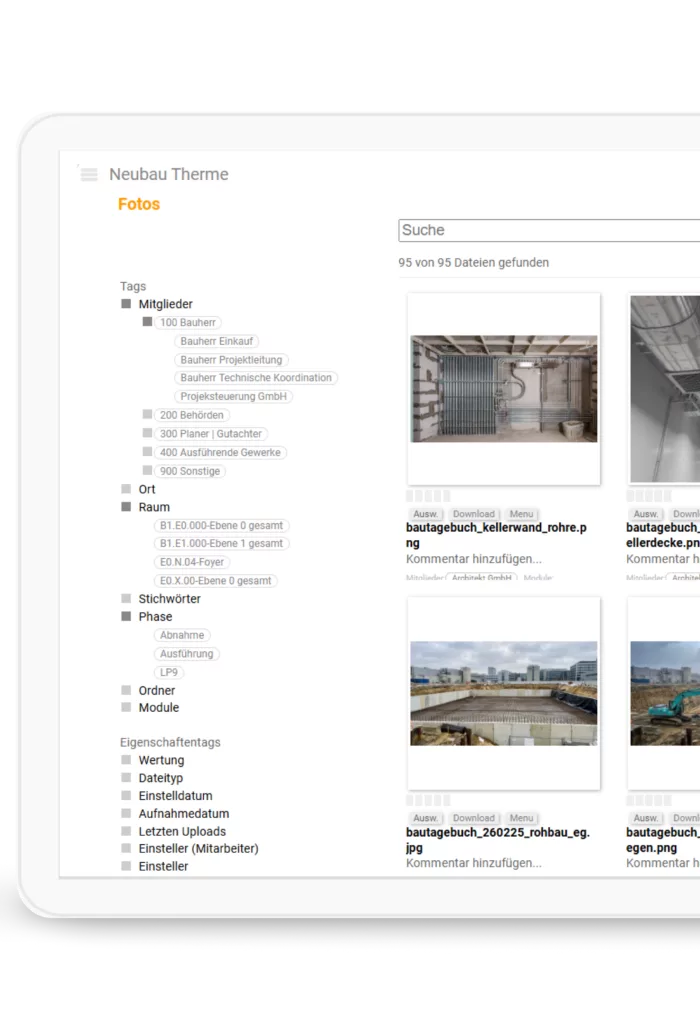
Photos
Don’t just collect media in one place; research it systematically as well. Organised in a way that’s easy to follow, clearly categorised and quick to find.
Media Database
Filter
Quick Search Using Keywords
Export
“The photos app is an absolutely invaluable tool for me. It’s quick and easy to use, and everyone has immediate access to the photos. By uploading photos regularly, we’ve built up a great record of all the construction progress.”
Jens Esslinger, Project Manager at EEW Energy from Waste GmbH
Recorded on Site. Carry On Working Seamlessly in the Office.

“Many contractors were more than happy to keep the site diary and quickly realised the significant added value it offered them.”
Jens Esslinger, Project Manager at EEW Energy from Waste GmbH
Developed to Meet High Standards in Data Protection and Data Security
All project members work with sensitive data, plans, and documents on a daily basis. Our SaaS solutions are designed to store your data in ISO-certified data centers in Germany and ensure full GDPR compliance.
German Data Centers
GDPR-compliant (AV)
Information Security ISO 27001
Transparent Processes (TOMs)
Flexible Security Features
Quality Management ISO 9001

FAQs
Brief Answers to Key Questions About Construction Site Tools and Their Benefits for Transparent Collaboration and Documentation Within a Project
The construction site tools bring together key functions for day-to-day work on site: defect management, site diary and mobile photo documentation. Tasks can be recorded, assigned and documented directly on site, and then processed further within the project context. This creates a seamless workflow for site managers between the site and the office, whilst at the same time improving transparency, traceability and coordination within the project for planning, project management and other stakeholders.
The construction site tools are primarily designed for site managers, architects involved in site supervision, project managers and other stakeholders during the construction phase. They provide support wherever processes on the construction site need to be recorded and documented in a timely manner and processed further in the context of the project. They also add value to planning and construction project management, as information is available in a more structured, faster and more traceable format.
In day-to-day site management, construction site tools help to record processes directly where they occur. This reduces the need for subsequent rework, speeds up documentation and improves the overview of outstanding issues, responsibilities and the current status of work. At the same time, this creates a seamless workflow between the construction site and the office, without the need to consolidate information from different sources at a later stage.
In Poolar.Project, the construction site tools are not a separate add-on, but form part of the central project workspace. Information from the construction site is not managed separately, but is maintained within the same project context as plans, documents and stakeholders. This ensures that the construction site and the office work from the same information base. This supports consistent collaboration across roles, trades and project phases.
Standalone solutions often address only a single sub-process, such as defect recording or photographic documentation. In practice, however, this quickly leads to data disjointness, duplicate data storage and additional coordination work. As part of a CDE, construction site tools are more closely integrated with the rest of the project: Information remains in context, is centrally available and does not need to be gathered from various systems or transferred retrospectively. Furthermore, responsibilities can be conveniently assigned, as project members – along with their contact details and tasks – are already part of the project workspace. There is no need to maintain contact details in multiple places.
Construction site tools support structured, traceable project documentation. Processes are recorded in a timely manner, clearly assigned and filed in the context of the project. This makes it easier to track developments, responsibilities and processing statuses at a later date. Well-organised documentation is particularly important when it comes to defects, daily events and photographic records, as it enables decisions, processes and facts to be recorded in a reliable manner.
The construction site tools enable defects to be documented and pinpointed directly on site, and then followed up within the projects. This transforms a mere observation into a structured process with clear accountability. For site management and project members, it becomes clearer exactly what has been identified, where action is required and what the current status of the work is. This creates a greater sense of accountability when dealing with outstanding issues.
Construction site tools create a better link between operational work on site and further processing within the project. Information from the construction site is not only available locally or in individual notes, but can also be reused by other stakeholders in the correct context. This improves transparency, shortens coordination cycles and facilitates collaboration between the construction site, the planning team and project management.
In construction projects, it is usually not enough simply to record information. What is crucial is that it can be reused in the right context. This is precisely where a key advantage of integrated construction site tools lies: defects, daily events and photographic documentation do not exist in isolation from the project, but remain part of the same data and working context. This makes further processing more consistent and project communication more robust.